

Search engine optimisation represents the cornerstone of digital marketing success, determining whether your business appears prominently when potential customers search for your products or services. Whilst paid advertising stops delivering results the moment you stop spending, effective SEO generates sustainable organic traffic that compounds over time. Yet many businesses struggle with SEO’s technical complexity, constantly changing algorithms, and the patience required for meaningful results. Understanding core principles, avoiding costly mistakes, and implementing strategic approaches transforms SEO from mysterious dark art into manageable marketing discipline driving measurable business growth.
Why SEO Matters for Business Success
Over 93% of online experiences begin with search engines, making visibility in search results crucial for reaching potential customers. Businesses ranking on the first page of Google capture the vast majority of clicks, whilst those relegated to page two or beyond receive negligible traffic regardless of how compelling their offerings might be.
SEO delivers exceptional return on investment compared to other marketing channels. Unlike paid advertising requiring continuous expenditure, strong organic rankings generate ongoing traffic without per-click costs. Quality SEO compounds over time—each content piece, backlink, and technical improvement builds upon previous work, creating momentum that accelerates results whilst reducing relative effort required for continued growth.
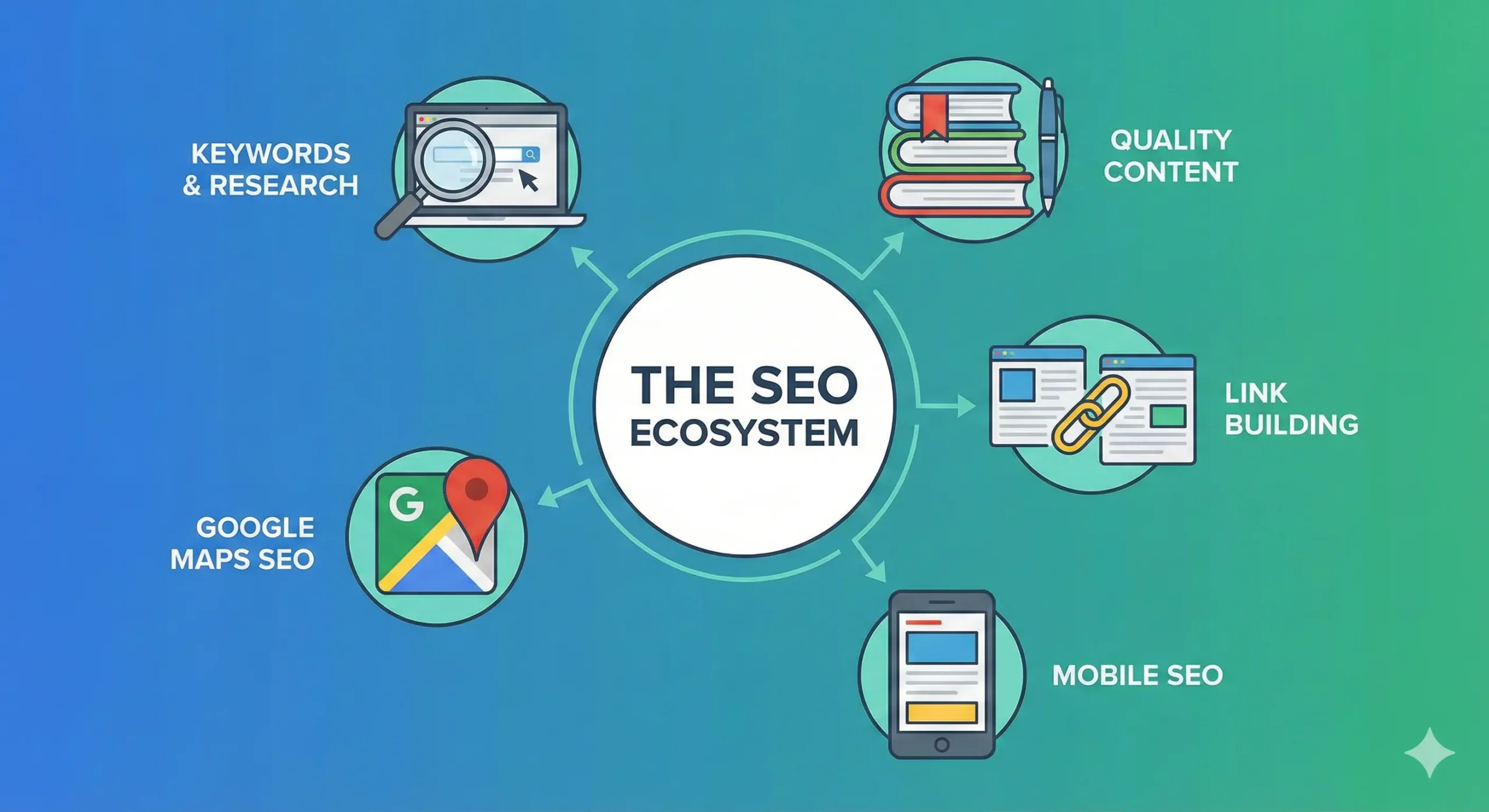
Core Components of Effective SEO
#1 Technical SEO Foundations
Search engines must crawl, index, and understand your website before ranking it appropriately. Technical SEO ensures sites meet these fundamental requirements through proper structure, fast loading speeds, mobile responsiveness, and clean code. XML sitemaps guide search engines through your content, whilst robots.txt files prevent indexing of irrelevant pages.
Site speed profoundly impacts both user experience and search rankings. Google prioritises fast-loading sites, meaning technical optimisation directly influences visibility. Compressed images, efficient code, quality hosting, and content delivery networks all contribute to performance that satisfies both search engines and visitors.
Security matters increasingly for SEO success. HTTPS encryption protects user data whilst signalling trustworthiness to search engines. Sites lacking SSL certificates face ranking penalties and browser warnings that deter visitors before they even view your content.
#2 On-Page SEO Optimisation
Individual page optimisation ensures search engines understand your content’s topic and relevance. Title tags, meta descriptions, heading structures, and URL formats all communicate page purpose whilst influencing click-through rates from search results pages.
Strategic keyword placement proves essential without resorting to obvious stuffing that damages readability. Natural incorporation of relevant terms throughout content, headings, and image alt text helps search engines categorise pages whilst maintaining quality user experiences. Modern SEO emphasises semantic relationships and topic authority over crude keyword density.
Internal linking distributes authority throughout sites whilst helping search engines discover and understand content relationships. Strategic links guide both users and search crawlers toward important pages, improving indexation whilst enhancing navigation and engagement.
#3 Content Strategy and Quality
Content remains SEO’s fundamental currency. Search engines aim to surface the most relevant, authoritative, and helpful content for each query. Creating comprehensive resources addressing user questions thoroughly outperforms thin, keyword-focused articles offering minimal value.
Regular content publication demonstrates active sites worth frequent crawling whilst establishing topical authority. Blog posts, guides, case studies, and resources attract links naturally whilst targeting long-tail keywords that convert effectively despite lower search volumes.
Content must satisfy user intent—informational queries require detailed explanations, navigational searches need clear pathways to specific pages, and transactional queries demand product information and purchase facilitation. Aligning content with search intent dramatically improves engagement metrics that influence rankings.
#4 Off-Page SEO and Link Building
Backlinks from reputable sites signal authority and trustworthiness to search engines. Quality matters far more than quantity—a single link from a respected industry publication delivers more value than dozens from low-quality directories. Natural link profiles develop through genuinely useful content earning citations, though strategic outreach accelerates the process.
Local citations, industry directories, and professional associations provide foundational links whilst supporting local search visibility. Guest posting on relevant blogs, creating linkable resources like original research or tools, and building relationships with industry influencers all generate valuable backlinks supporting ranking improvements.
Avoid manipulative link schemes violating search engine guidelines. Purchased links, link farms, and reciprocal linking networks risk penalties that devastate rankings, sometimes permanently. Sustainable SEO emphasises earning links through quality and relevance rather than shortcuts promising unrealistic rapid results.
Local SEO for Regional Businesses
#1 Google Business Profile Optimisation
Businesses serving specific geographical areas must optimise for local search through Google Business Profiles providing essential information—location, hours, services, and contact details. Complete, accurate profiles with regular updates, customer reviews, and quality images significantly improve local search visibility.
Local citations across directories like Yelp, Thomson Local, and industry-specific platforms reinforce geographical relevance. Consistent name, address, and phone number (NAP) information across all platforms prevents confusion that damages local rankings.
#2 Location-Specific Content and Keywords
Regional businesses benefit from content addressing local topics, community involvement, and area-specific customer needs. Location pages optimised for specific service areas capture searches including geographical qualifiers—”plumber in Kilmarnock” or “accountant near Troon.” Specialists in services like SEO Ayrshire understand regional search patterns and competitive landscapes, implementing strategies that resonate with local audiences whilst maximising visibility for relevant geographical searches.
Customer reviews significantly influence local search rankings whilst building trust with potential clients. Encouraging satisfied customers to leave Google reviews, responding professionally to all feedback, and addressing concerns promptly demonstrates engagement that both search engines and prospects value highly.
Common SEO Mistakes to Avoid
#1 Neglecting Mobile Optimisation
Mobile-first indexing means Google primarily uses mobile versions of sites for ranking purposes. Sites offering poor mobile experiences face ranking penalties regardless of desktop performance. Responsive design, fast mobile loading, and touch-friendly navigation prove essential for modern SEO success.
#2 Thin or Duplicate Content
Low-quality pages offering minimal value dilute site authority whilst wasting crawl budget on content unlikely to rank. Duplicate content confuses search engines about which version to rank, often resulting in none appearing prominently. Focus on comprehensive, original content addressing topics thoroughly rather than numerous shallow pages targeting slight keyword variations.
#3 Ignoring User Experience Signals
Search engines increasingly consider user engagement metrics—bounce rates, time on site, pages per session—when determining rankings. Sites frustrating visitors through poor navigation, intrusive pop-ups, or confusing layouts face ranking challenges regardless of technical optimisation. Quality SEO balances search engine requirements with exceptional user experiences.
#4 Expecting Overnight Results
SEO requires patience. Meaningful ranking improvements typically take 3-6 months, with competitive industries demanding longer timeframes. Promises of immediate first-page rankings signal either paid advertising (not SEO) or manipulative tactics risking penalties. Sustainable strategies emphasise steady progress toward long-term dominance rather than quick fixes.
Measuring SEO Success
#1 Key Performance Indicators
Track organic traffic, keyword rankings, conversion rates, and engagement metrics revealing SEO effectiveness. Google Analytics and Search Console provide comprehensive data showing which content attracts visitors, how users find your site, and which pages convert most effectively.
Monitor rankings for target keywords whilst understanding that positions fluctuate regularly. Focus on overall visibility trends rather than obsessing over daily ranking changes. Diversified keyword portfolios protect against algorithm updates affecting specific terms.
#2 Continuous Improvement
SEO demands ongoing optimisation rather than one-time setup. Algorithm updates, competitive changes, and evolving user behaviour require regular strategy refinement. Monthly reviews identify opportunities whilst ensuring tactics remain aligned with current best practices and business objectives.
Frequently Asked Questions
1. How long does SEO take to show results?
Most businesses notice initial improvements within 3-4 months, with significant ranking gains requiring 6-12 months of consistent effort. Competitive industries demand longer timeframes, whilst less competitive niches show faster progress. Patience proves essential—sustainable SEO builds gradually rather than delivering overnight success.
2. Can I do SEO myself or should I hire professionals?
Basic SEO proves manageable for motivated business owners willing to learn fundamentals. However, competitive markets, technical complexity, and time requirements often justify professional expertise. Many businesses benefit from hybrid approaches—handling content creation internally whilst outsourcing technical optimisation and link building to specialists.
3. How much should SEO cost?
Pricing varies based on competitiveness, business size, and service scope. Monthly retainers typically range from £500-2,000+ for small to medium businesses, with enterprise-level campaigns requiring significantly higher investment. Beware unrealistically cheap services often employing risky tactics or delivering minimal actual work.
4. Does social media affect SEO?
Social signals don’t directly influence rankings, but social media drives traffic, builds brand awareness, and generates engagement that indirectly supports SEO. Content promoted through social channels attracts links and mentions whilst expanding reach beyond organic search alone.
5. What’s the difference between SEO and paid search?
SEO generates organic visibility through content and optimisation, delivering ongoing traffic without per-click costs. Paid search provides immediate visibility through advertisements charged per click. Both complement each other—SEO builds sustainable long-term presence whilst paid search delivers controllable short-term results.
Conclusion
Effective search engine optimisation combines technical excellence, quality content, and strategic link building into cohesive approaches that generate sustainable organic visibility. By understanding core principles, avoiding common pitfalls, and maintaining patient consistency, businesses build search presence that drives qualified traffic whilst establishing industry authority. Whether managing SEO internally or partnering with experienced specialists, investing in quality optimisation delivers compounding returns through enhanced visibility, increased traffic, and measurable business growth that justifies initial effort and expenditure many times over.